
If you follow headlines, it sounds like artificial intelligence suddenly appeared in late 2022. One product launch and suddenly everything became “AI-powered.”
That story is convenient. It is also inaccurate.
What changed in 2022 was not the existence of AI. What changed was visibility. For the first time, millions of people could interact directly with powerful models through simple conversational interfaces. AI left the background and entered everyday awareness.
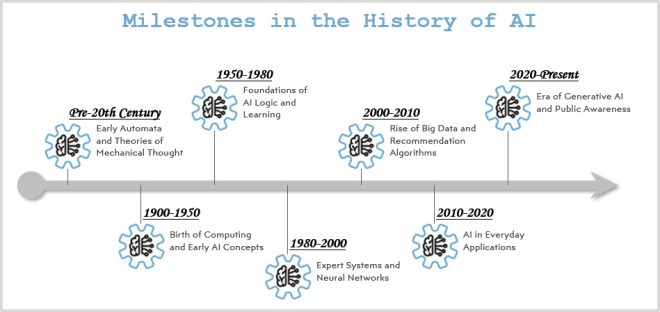
Long before that moment, AI had already been embedded into real-world systems. According to IBM’s historical overview of artificial intelligence, early AI research and practical systems date back decades, including rule-based expert systems, statistical learning methods, and industrial automation tools that shaped decision support and operations long before generative models existed (IBM, “History of Artificial Intelligence”: https://www.ibm.com/think/topics/history-of-artificial-intelligence).
In practical terms, this meant AI started quietly. Hospitals used decision-support tools. Banks relied on credit scoring models. Companies deployed fraud detection systems. None of this looked futuristic. It looked like software doing administrative work. But it mattered. These systems influenced who received loans, how risk was assessed, and how resources were allocated.
As computing power and data availability expanded, AI moved from internal optimization into consumer-facing platforms. Recommendation systems began shaping what people watched, read, and bought. Search engines ranked information. Social platforms optimized feeds for engagement. At this point, AI stopped being invisible infrastructure and started influencing behavior at scale, even if users did not label it as artificial intelligence.
Then automation expanded further. Hiring tools screened resumes. Facial recognition systems were tested in public spaces. Predictive models entered law enforcement and public services. This is where ethical concerns became impossible to ignore. Bias surfaced. Accountability blurred. Oversight lagged behind deployment. Efficiency moved faster than governance.
By the time generative AI tools became widely accessible in 2022, the foundation had already been laid. What felt sudden to the public was actually the result of decades of gradual integration. The real shift was not capability alone. It was accessibility. People could finally see, touch, and test the technology themselves.
That visibility matters because it forces a larger question: what are we actually optimizing for?
AI systems do not make neutral decisions. They optimize objectives chosen by humans. Engagement. Speed. Cost reduction. Scale. When those incentives dominate, outcomes follow. Misinformation spreads faster. Outrage is rewarded. Complex human judgment gets compressed into scores and probabilities.
The uncomfortable truth is that technology does not drift on its own. It reflects priorities. If we do not slow down to define those priorities deliberately, we default to whatever maximizes short-term performance metrics.
The future of AI is not primarily about smarter machines. It is about whether humans remain willing to take responsibility for the systems they deploy. How much judgment we are willing to outsource. How much transparency we demand. How much friction we allow in the name of ethical restraint.
AI did not arrive in 2022. What arrived was public awareness. What comes next depends on whether we use that awareness to guide development thoughtfully, or simply react to whatever comes next.
Read more:
1. Stanford Human-Centered AI (HAI)
Stanford’s AI Index and research summaries are widely cited and policy-relevant, focusing on real-world deployment, impact, and trends, not marketing:
– https://hai.stanford.edu/research
– https://aiindex.stanford.edu
2. National Institute of Standards and Technology (NIST)
US government authority on AI standards and risk frameworks:
– https://www.nist.gov/artificial-intelligence
3. MIT Technology Review
Historical context and long-form reporting on AI’s real-world use:
– https://www.technologyreview.com/topic/artificial-intelligence/
4. OECD AI Policy Observatory
International policy-oriented view of AI development:
– https://oecd.ai
5. Association for the Advancement of Artificial Intelligence (AAAI)
One of the oldest AI research organizations:
– https://aaai.org/about-aaai/
 Thinking Outward
You must be logged in to post a comment.