When Hiring Becomes Automated: Where Should Human Judgment Stay?

Applying for a job used to mean sending a résumé and waiting for a person to read it. Today, in many organizations, the first reviewer is software. Applicant tracking systems scan keywords. Screening tools rank candidates. Some systems score video interviews based on speech patterns or facial cues. The process is faster. It is scalable. It is efficient.

But efficiency is not the same as fairness. The question is not whether hiring can be automated. Parts of it already are. The real question is this: Where should human judgment remain?

The Promise of Automation in Hiring

From an organizational perspective, automated hiring tools solve real problems. Companies receive hundreds, sometimes thousands, of applications for a single role. Human review of every résumé is expensive and time-consuming. Software can filter, rank, and narrow the pool quickly. In theory, this reduces bias by applying consistent criteria. It standardizes evaluation. It creates a record of decisions. Used carefully, automation can assist recruiters. The problem begins when assistance quietly turns into replacement.

Pre-Filtering Is Still a Decision

If a system eliminates candidates before a human ever sees them, that is not a neutral sorting step. It is a decision.

The criteria embedded in the software determine:

  • Which keywords matter
  • Which schools or job titles are weighted
  • How employment gaps are interpreted
  • What counts as relevant experience

Those choices reflect assumptions. Assumptions reflect values.

And values shape outcomes.

When hiring teams say, “The system filtered them out,” it sounds procedural. In reality, the organization defined the filters. The system is enforcing human-defined priorities at scale.

The Risk of Narrow Signals

Automated systems tend to rely on structured, measurable data. Keywords. Years of experience. Degree requirements. Past job titles. But many strong candidates do not fit clean patterns. Career changers. Military veterans. People reentering the workforce. Candidates from nontraditional educational paths. Human judgment can recognize potential. Software is better at recognizing similarity. If similarity becomes the primary signal, diversity of experience may shrink. That is not necessarily malicious. It is predictable.

The Human-in-the-Loop Question

Many organizations say they keep a human in the loop. That sounds reassuring. But what does that mean in practice?

If a recruiter receives a shortlist generated by software and must move quickly, the system’s ranking heavily influences the outcome. Reviewing every rejected application is rarely feasible. In this setup, humans often validate system output rather than independently evaluate candidates. Oversight exists. Influence shifts. The distinction matters.

What Should Remain Human?

Not every part of hiring requires deep human deliberation. Scheduling interviews can be automated. Collecting applications can be automated. Tracking candidate progress can be automated. But decisions that shape someone’s livelihood deserve careful scrutiny.

Humans should retain responsibility for:

  • Final evaluation of candidates
  • Reviewing edge cases
  • Monitoring patterns of exclusion
  • Questioning system outputs
  • Periodically auditing criteria

If hiring becomes a fully automated pipeline, accountability becomes harder to trace.

Efficiency Is a Goal. It Is Not the Only Goal.

Organizations understandably want faster hiring cycles and lower administrative costs. Those are legitimate goals. But if speed becomes the dominant metric, other values may quietly weaken. Fairness. Context. Potential. Judgment. Hiring is not just a sorting problem. It is a decision about people’s futures. Reducing it entirely to pattern matching risks narrowing opportunity.

A Slower Question

The debate around AI in hiring often focuses on whether the technology works. A more important question might be: Are we comfortable allowing automated systems to define who gets seen and who does not?

Technology can assist judgment. It should not quietly replace it. As automation becomes more capable, maintaining meaningful human review will require intention. It may also require accepting that some processes should move more slowly. In hiring, that tradeoff may be worth it.


⚖️ Legal and Regulatory Case Examples

Workday AI Bias Lawsuit

There is a real, ongoing case in U.S. courts alleging that Workday’s automated hiring software discriminated against a job seeker on the basis of race, age, and disability, forcing the case to move forward rather than be dismissed. The U.S. Equal Employment Opportunity Commission (EEOC) has even filed legal briefs arguing that the tool functions like an “employment agency” under civil rights law.

https://www.reuters.com/legal/transactional/eeoc-says-workday-covered-by-anti-bias-laws-ai-discrimination-case-2024-04-11

📚 Academic and Industry Research on Bias in Hiring Automation

Bias and Discrimination in Algorithmic Hiring

Scholars have documented how automated recruitment tools can reproduce or even amplify systemic bias already present in hiring data, influencing outcomes for gender, race, and other protected characteristics.

https://www.nature.com/articles/s41599-023-02079-x

Algorithmic Bias Case Studies

There are published case studies (including tribunal examples in the UK) exploring how AI recruitment systems can produce discriminatory results and how these outcomes have been legally challenged.

https://iuslaboris.com/insights/discrimination-and-bias-in-ai-recruitment-a-case-study

🧪 Empirical Findings on Bias in Automated Ranking

University of Washington Research

Newer research found that large language models used to rank resumes exhibited significant racial and gender bias, favoring applicants associated with certain demographics over others even when qualifications were identical.

https://www.washington.edu/news/2024/10/31/ai-bias-resume-screening-race-gender

📊 Regulatory Context and Enforcement Guidance

EEOC Focus on Automated Systems

The EEOC has explicitly made algorithmic fairness and use of automated systems in employment decisions a priority area, indicating real regulatory attention on how these tools are used in hiring.

https://www.eeoc.gov/2023-annual-performance-report

⚖️ Practical Compliance Guidance for Employers

Law firms and compliance groups have published white papers advising employers on how to manage legal risk when adopting AI hiring tools, including bias testing, documentation, monitoring, and vendor oversight.

https://www.harrisbeachmurtha.com/insights/ai-assisted-hiring-in-2026-managing-discrimination-risk

🧠 Theoretical and Ethical Research

Empirical and Survey Research

Research interviewing HR professionals and developers about biases in AI recruitment surfaces themes about how these systems can embed subjective assumptions into automated decisions.

https://www.tandfonline.com/doi/full/10.1080/09585192.2025.2480617

⚠️ Historical Example

There are well-documented earlier cases, such as an Amazon AI hiring tool that accidentally learned to favor male candidates because it was trained on a male-dominated resume dataset, which became a cautionary tale about bias in automation.

While not recent, this example is widely cited and helps illustrate how systems inherit patterns from data.

https://www.axios.com/2018/10/10/amazon-ai-recruiter-favored-men
Automation Does Not Eliminate Work. It Redistributes It.

Every wave of automation comes with the same promise: less work.

Machines will handle the repetitive tasks. Software will increase efficiency. AI will reduce administrative burden. But history tells a more complicated story. Automation rarely eliminates work entirely. It changes who does it, how it is done, and what kinds of work become more valuable. The shift is not about disappearance. It is about redistribution.

A Brief Look at the Data

According to data from the U.S. Bureau of Labor Statistics, employment in certain production and clerical roles has declined over decades, while roles in technology, healthcare, and professional services have expanded. At the same time, total employment has continued to grow, even as automation increased across industries.

That pattern is not new. Mechanization reduced agricultural labor dramatically in the 20th century. Manufacturing automation reshaped factory work. Digital systems reduced some clerical roles while expanding demand for analysts, engineers, and service professionals.

The labor market adapts. But adaptation does not mean neutrality. Shifts create winners and losers. They change required skills. They create friction.

According to BLS projections, total U.S. employment is expected to grow by about 4 percent between 2023 and 2033, adding millions of jobs overall, especially in healthcare and professional sectors, even as automation reshapes specific roles. Click here for more information.

The Work Does Not Vanish. It Moves.

When a system automates part of a process, several things usually happen:

  1. Routine tasks shrink.
  2. Oversight work increases.
  3. Exception handling grows.
  4. New technical roles emerge.

Take hiring software as one example.

Automated screening tools can process thousands of applications quickly. That reduces manual review time. But someone must:

  • Configure the screening criteria
  • Audit outcomes
  • Handle edge cases
  • Address complaints
  • Maintain the system

The nature of the work changes. It does not disappear.

The same pattern appears in logistics, finance, healthcare, and customer service.

The Hidden Shift: Cognitive Load

One of the least discussed consequences of automation is cognitive redistribution.

When repetitive tasks are automated, remaining work often becomes more complex. Humans handle ambiguity, exceptions, judgment calls, and system failures.

This can increase mental strain rather than reduce it.

An automated workflow may reduce keystrokes. It may also increase monitoring responsibility and error accountability. Workers become supervisors of systems rather than performers of tasks.

That is not necessarily easier work. It is different work.

Skill Polarization Is Real

Labor economists have documented what is often called skill polarization: growth in high-skill and low-skill roles, with pressure on certain middle-skill occupations.

Automation contributes to this pattern.

Tasks that are routine and predictable are easier to automate. Tasks requiring interpersonal skill, creativity, physical dexterity, or advanced analytical reasoning are harder to replace.

The result is not mass unemployment. It is structural change.

The challenge is not whether jobs will exist. It is whether workers can transition into new roles without severe disruption.

Over the past several decades, manufacturing employment in the U.S. has declined by millions even as output remained strong, illustrating how technological change can reduce labor needs in certain sectors while the broader economy continues to evolve. Click here for more information.

The Incentive Question Reappears

Organizations often adopt automation to:

  • Reduce costs
  • Increase throughput
  • Improve margins
  • Respond to competitive pressure

Those are rational business goals.

But if the only metric considered is efficiency, broader workforce impacts may be treated as secondary. Retraining programs, transition support, and long-term workforce planning require investment. Not all organizations prioritize them equally.

Automation decisions reflect priorities, not inevitability.

What Should We Be Asking?

Instead of asking, “Will AI take all the jobs?” a more useful question might be:

Where is work being redistributed, and who bears the adjustment cost?

Are we preparing workers for transitions?
Are educational systems adapting fast enough?
Are organizations reinvesting productivity gains into workforce development?

Automation is not inherently destructive. But unmanaged redistribution creates instability.

A Slower Conclusion

Technology has always reshaped labor. From mechanized agriculture to industrial robotics to digital workflows, the pattern is consistent.

Work changes.

The responsibility lies not in preventing technological advancement, but in managing its effects deliberately.

Automation does not eliminate work. It reallocates effort, skill, and opportunity.

The real question is whether we guide that redistribution responsibly, or allow it to unfold without planning.

We talk about artificial intelligence as if it has agency.

“The system decided.”
“The algorithm flagged it.”
“The model rejected the application.”

The language makes it sound like something independent made a judgment.

But AI systems do not choose their goals. People do.

That distinction matters more than most discussions admit.


AI Optimizes What We Tell It to Optimize

Every AI system is built to improve something.

Clicks.
Engagement.
Fraud detection accuracy.
Cost reduction.
Speed.
Risk scoring precision.

Those performance goals are defined by people inside organizations. They reflect business models, budget pressures, and competitive realities. When an AI system produces a harmful or questionable outcome, the more honest question is not “Why did the machine do this?” It is “What were we measuring as success?”

If engagement is the primary metric, sensational content will surface.
If cost reduction is the priority, human review will shrink.
If speed matters more than careful evaluation, edge cases will be overlooked.

The system is doing exactly what it was designed to do.


The Language of “Autonomy” Softens Accountability

It is convenient to describe AI systems as autonomous. It shifts focus away from decision-makers.

When hiring software screens out candidates, organizations can say the model generated the shortlist. When credit decisions are automated, institutions can point to risk scores. When content moderation fails, platforms can cite scale.

But automation does not remove responsibility. It changes where responsibility sits.

Responsibility belongs to those who:

  • Define what success looks like
  • Choose what data the model learns from
  • Decide acceptable error rates
  • Approve deployment
  • Determine how much human oversight remains

Calling a system “autonomous” does not make it self-governing.


Scale Amplifies Small Choices

The deeper issue is not intelligence. It is scale.

AI systems operate across thousands, sometimes millions, of decisions. Small design choices, when repeated at scale, become structural patterns.

A slight bias in training data can affect large numbers of applicants. A small engagement boost can amplify misleading content widely. A decision to remove human review from certain processes can reshape outcomes for entire groups.

Technology scales efficiently. Oversight and reflection do not scale automatically.

Slowing down costs money. Careful review takes time. Organizations feel pressure to move quickly.

That pressure shapes system behavior long before the public notices.


The Real Question

The question is not whether AI should exist. It already does. The real question is this:

What are we optimizing for?

If the primary measure of success is speed, then speed will dominate.
If the primary measure of success is profit, then profit will dominate.
If the primary measure of success is fairness or reliability, those values must be built into the evaluation process.

AI reflects the priorities embedded in its design.

Machines do not set those priorities. We do.


A Moment of Reflection

The next time a headline says, “AI made this decision,” pause for a moment.

Who defined the performance goals?
Who approved the rollout?
Who benefits if the system performs well?
Who absorbs the downside when it does not?

AI is not autonomous. It operates according to the targets we establish.

If we want different outcomes, we need to examine the goals we reward.

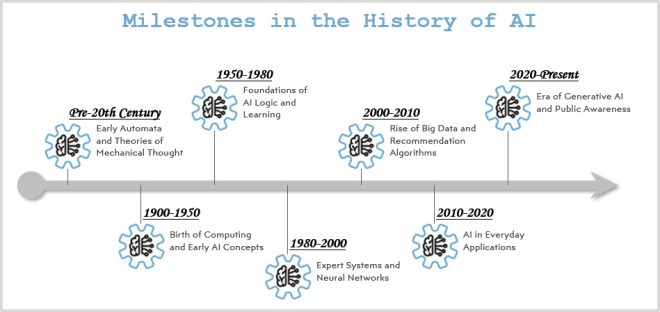
AI Did Not Arrive in 2022

If you follow headlines, it sounds like artificial intelligence suddenly appeared in late 2022. One product launch and suddenly everything became “AI-powered.”

That story is convenient. It is also inaccurate.

What changed in 2022 was not the existence of AI. What changed was visibility. For the first time, millions of people could interact directly with powerful models through simple conversational interfaces. AI left the background and entered everyday awareness.

Long before that moment, AI had already been embedded into real-world systems. According to IBM’s historical overview of artificial intelligence, early AI research and practical systems date back decades, including rule-based expert systems, statistical learning methods, and industrial automation tools that shaped decision support and operations long before generative models existed (IBM, “History of Artificial Intelligence”: https://www.ibm.com/think/topics/history-of-artificial-intelligence).

In practical terms, this meant AI started quietly. Hospitals used decision-support tools. Banks relied on credit scoring models. Companies deployed fraud detection systems. None of this looked futuristic. It looked like software doing administrative work. But it mattered. These systems influenced who received loans, how risk was assessed, and how resources were allocated.

As computing power and data availability expanded, AI moved from internal optimization into consumer-facing platforms. Recommendation systems began shaping what people watched, read, and bought. Search engines ranked information. Social platforms optimized feeds for engagement. At this point, AI stopped being invisible infrastructure and started influencing behavior at scale, even if users did not label it as artificial intelligence.

Then automation expanded further. Hiring tools screened resumes. Facial recognition systems were tested in public spaces. Predictive models entered law enforcement and public services. This is where ethical concerns became impossible to ignore. Bias surfaced. Accountability blurred. Oversight lagged behind deployment. Efficiency moved faster than governance.

By the time generative AI tools became widely accessible in 2022, the foundation had already been laid. What felt sudden to the public was actually the result of decades of gradual integration. The real shift was not capability alone. It was accessibility. People could finally see, touch, and test the technology themselves.

That visibility matters because it forces a larger question: what are we actually optimizing for?

AI systems do not make neutral decisions. They optimize objectives chosen by humans. Engagement. Speed. Cost reduction. Scale. When those incentives dominate, outcomes follow. Misinformation spreads faster. Outrage is rewarded. Complex human judgment gets compressed into scores and probabilities.

The uncomfortable truth is that technology does not drift on its own. It reflects priorities. If we do not slow down to define those priorities deliberately, we default to whatever maximizes short-term performance metrics.

The future of AI is not primarily about smarter machines. It is about whether humans remain willing to take responsibility for the systems they deploy. How much judgment we are willing to outsource. How much transparency we demand. How much friction we allow in the name of ethical restraint.

AI did not arrive in 2022. What arrived was public awareness. What comes next depends on whether we use that awareness to guide development thoughtfully, or simply react to whatever comes next.

Read more:

1. Stanford Human-Centered AI (HAI)

Stanford’s AI Index and research summaries are widely cited and policy-relevant, focusing on real-world deployment, impact, and trends, not marketing:
https://hai.stanford.edu/research
https://aiindex.stanford.edu

2. National Institute of Standards and Technology (NIST)

US government authority on AI standards and risk frameworks:
https://www.nist.gov/artificial-intelligence

3. MIT Technology Review

Historical context and long-form reporting on AI’s real-world use:
https://www.technologyreview.com/topic/artificial-intelligence/

4. OECD AI Policy Observatory

International policy-oriented view of AI development:
https://oecd.ai

5. Association for the Advancement of Artificial Intelligence (AAAI)

One of the oldest AI research organizations:
https://aaai.org/about-aaai/